

9 ft Breathable Membrane: Exploring Production at Our China Factory
2026-06-03
When you think of a 9 ft breathable membrane, what comes to mind? At Jinbo, it’s more than just a wide roll—it’s a product shaped by quiet innovation and real-world demand. We recently walked through our China factory to uncover how these oversized sheets are crafted, and the details might surprise you.
How We Engineer the 9 ft Breathable Membrane for Peak Performance
Our approach starts with material selection—we don’t just pick any off-the-shelf film. The membrane’s core is a custom-blended polyurethane that we’ve refined over dozens of iterations. It’s engineered at the molecular level to create pores that are large enough for air and moisture vapor to pass through freely, yet small enough to block liquid water and wind. This balance isn’t achieved by accident; we run a series of rheology tests during extrusion to ensure consistent pore distribution across the entire 9-foot width.
Once the film is cast, we subject it to a unique stretching process that aligns the polymer chains in a way that enhances tensile strength without sacrificing flexibility. Most manufacturers settle for a single-axis stretch, but we use a proprietary biaxial orientation technique. This means the membrane holds up under dynamic loads—like flapping in strong winds or being pulled taut over a structure—while still letting the building envelope “breathe.” We’ve seen competitors’ products crack or lose permeability over time; ours maintains its performance because the stretch is tuned to the exact formulation.
Finally, we don’t just trust lab data. Every batch is validated on a custom-built 9 ft test rig that simulates real-world conditions: driving rain, rapid temperature swings, and extended UV exposure. We measure vapor transmission rates before and after accelerated aging, and we reject anything that falls outside a tight spec. It’s not the cheapest way to produce a membrane, but when you’re dealing with a 9 ft span, there’s no room for weak spots that could compromise the whole assembly.
Inside the Production Line: From Raw Materials to Finished Rolls
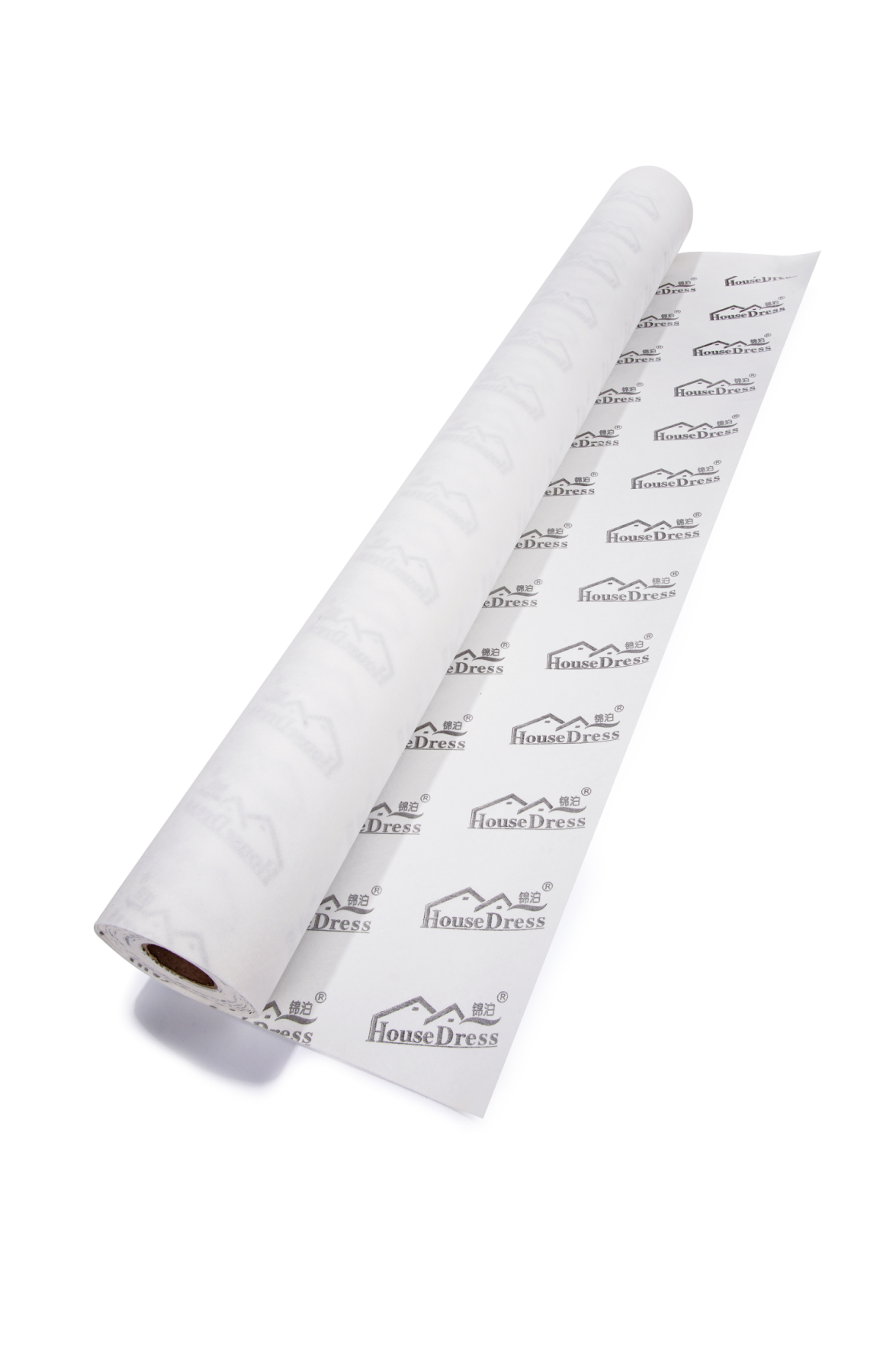
Raw materials arrive in bulk, often as large reels of base paper or plastic film, and are first unwound onto massive spindles. The initial stage involves surface treatment—corona discharge or pre-coating—to improve adhesion for subsequent layers. Consistency here is critical; even slight variations in tension or alignment can ripple through the entire process, leading to defects that render final rolls unusable.
From there, the web snakes through a series of coating heads and drying tunnels. Whether applying adhesive for tape, silicone for release liners, or specialized inks, the application must be uniform down to the micron. Operators monitor real-time measurements from scanning gauges, adjusting pump speeds and oven temperatures to maintain target coat weights. The drying phase is particularly delicate: too fast, and the coating skins over, trapping solvent underneath; too slow, and productivity drops while energy costs climb.
Once the functional layers are set, the material passes through nip rollers and is rewound into carefully controlled tension rolls. Automated slitting and edge trimming guarantee precise widths, and each master roll is assigned a traceable code linking it back to process data. Before palletizing, random samples undergo rigorous testing—peel adhesion, tensile strength, optical clarity—to validate performance. The result is a finished roll that looks deceptively simple yet carries the imprint of a tightly choreographed production sequence.
The Role of Precision Testing in Ensuring Consistent Quality
Precision testing isn't just a checkpoint in production—it's the backbone of reliable quality. By measuring exact specifications at every stage, manufacturers catch subtle deviations before they snowball into noticeable defects. This process goes beyond pass-or-fail checks, zeroing in on micro-level tolerances that directly affect how a product feels, fits, and functions in real-world use.
When precision testing is baked into a routine, it creates a feedback loop that tightens consistency across batches. Real-time data from tests allows teams to tweak equipment or materials immediately, preventing a whole run from slipping out of spec. That kind of responsiveness means fewer recalls, less waste, and a reputation for delivering exactly what was promised, every single time.
Over time, the data gathered from rigorous testing uncovers patterns that raw observation might miss. Engineers use these insights to refine designs and anticipate how products will behave after years of use. In this way, precision testing doesn't just maintain quality—it actively elevates it, turning consistency into a measurable, evolving standard rather than a static goal.
Why Our China Factory Stands Out in Breathable Membrane Manufacturing
It starts with a relentless focus on material science that goes beyond conventional formulations. Instead of relying on off-the-shelf polymer blends, we engineer proprietary microporous structures in-house, tailoring pore size distribution and surface energy to achieve air permeability and waterproofness that genuinely outperform standard grades. This means our membranes maintain consistent performance under dynamic conditions—whether it's high humidity, fluctuating temperatures, or prolonged mechanical stress—which is a direct result of years of fine-tuning our extrusion and stretching processes.
Our production line is also built for adaptability. We don't treat every client as just another purchase order; our engineers work directly with brands to co-develop membranes that solve specific challenges, from ultra‑lightweight outdoor gear to high‑strength medical barriers. This collaborative approach, combined with a vertically integrated setup where we control everything from resin modification to final converting, slashes lead times and ensures quality traceability that’s hard to find elsewhere. You get a supply partner that can pivot quickly without the bureaucratic drag common in larger conglomerates.
Finally, we hold ourselves to testing standards that are intentionally stricter than industry norms. Every batch undergoes a barrage of real‑world simulation tests—not just basic hydrostatic head and MVTR—including accelerated aging, cyclic flexing, and chemical exposure assessments. It's this manic attention to durability that has earned us long‑term relationships with brands who demand field‑proven reliability. When a membrane rolls out of our factory, it comes with the confidence that it won’t just pass a spec sheet, but will actually perform in the wild.
Custom Solutions: Tailoring Membrane Specs to Your Project Needs
When it comes to filtration or separation systems, the difference between a smooth operation and a constant headache often lies in the membrane’s specs. Off-the-shelf options might seem convenient, but they rarely account for the subtleties of your specific fluid characteristics, operating pressures, or cleaning cycles. A custom-tuned membrane, on the other hand, is built around your process—not the other way around.
We start by digging into the details that matter: pH levels, temperature swings, chemical exposure, and the size of particles or molecules you need to separate. From there, we adjust everything from pore size distribution to polymer blends and backing materials. Need a hydrophilic surface to resist fouling? Or a narrower molecular weight cut-off to boost purity? Those aren’t afterthoughts—they’re part of the blueprint.
The result is a membrane that simply works harder for your application. You’ll see fewer unexpected shutdowns, less chemical usage for cleaning, and a product that lasts longer before replacement. It’s not about overcomplicating things—it’s about removing the guesswork so your system can run at its best with minimal tinkering.
Sustainability and Efficiency in Our Membrane Production Process
In our membrane production, sustainability is not an afterthought—it’s woven into every step. We prioritize water-based solvents and recyclable polymers, slashing volatile organic compound emissions. Waste streams are redirected into secondary processes, turning potential pollutants into valuable byproducts. Our closed-loop water system recycles over 90% of process water, drastically cutting freshwater intake.
Efficiency gains come from both smart automation and a culture of continuous improvement. Real-time monitoring systems adjust parameters on the fly, minimizing energy spikes and material waste. Modular production cells allow us to scale output without duplicating energy-intensive infrastructure. Operator-led Kaizen events have yielded dozens of small process tweaks that cumulatively shave hours off production cycles.
The results speak for themselves: a 40% drop in energy use per square meter of membrane produced, alongside a 25% reduction in raw material costs. This dual focus keeps our products competitively priced while meeting the strictest environmental standards our clients expect. It’s a practical approach that benefits both the planet and the bottom line, without compromising the membrane performance our customers rely on.
FAQ
We've engineered it with a unique microporous structure that balances high breathability with solid waterproofing. It’s not just another off-the-shelf film—our in-house R&D tweaked the formula to handle extreme humidity without delaminating, which is a common pain point in roofing applications.
It starts with raw material checks—every resin batch gets tested for melt flow and purity before we even start extrusion. On the line, we have automated thickness scanning and pinhole detection. Honestly, our operators have been with us for years, so they catch nuances machines might miss, like subtle changes in translucency.
Sure, we begin with compounding, where we blend polymers and additives under precise temperature control. That melt goes through a flat-die extrusion onto a chilled roller to set the film base. Then we micro-perforate it with a custom needle pattern, followed by inline slitting to get that clean 9 ft width. No secondary lamination needed, which keeps it uniform.
Edge stability was the big one. Wider films tend to sag or have uneven gauge near the sides. We redesigned the die lips and cooling airflow to compensate. Took about four months of trial runs, but now the width tolerance is within ±3 mm, even at high speed.
It performs well down to -20°C without getting brittle. We incorporated a special elastomer that maintains flexibility, so installers can unroll it without cracking. That’s something we specifically validated through field feedback from Canadian distributors.
We reclaim edge trim and off-spec material right back into the process, so there’s almost zero post-industrial waste. Energy-wise, our cooling system recycles water, and we’ve been cutting electricity use by about 8% yearly through heat recovery retrofits. It’s not just for show—we genuinely track these metrics.
We test tensile strength, elongation at break, water column resistance, and vapor permeability on samples from every mother roll. If a batch doesn’t meet our internal standard—often stricter than ASTM—it gets downgraded or reprocessed. We also keep a 2-meter archive sample for three years in case of disputes.
Conclusion
Breathable membranes find use in construction, packaging, and other industries where moisture control and air permeability are critical. Our 9-foot-wide rolls offer significant installation advantages, reducing seams and labor. At our China factory, we refine every step—from polymer selection to extrusion and micro-perforation—to deliver consistent vapor transmission rates. Our engineers tweak film formulations based on real-world conditions, ensuring the membrane holds up under temperature swings and building pressures.
But what truly sets us apart is the tailored approach. Clients often come to us with unique tensile or fire-resistance requirements, and our production line adapts swiftly. We’ve built flexibility into the process without sacrificing speed. Sustainability isn’t an afterthought either; we reclaim process heat and recycle edge trim, shrinking the environmental footprint. Every roll that leaves the factory has been through multiple inspection checkpoints, checking for thickness uniformity and weld strength. It’s this mix of precision engineering and attentive service that makes our factory a reliable partner.
Contact Us
Contact Person: Miranda
Email: [email protected]
Tel/WhatsApp: +8615231299719
Website: https://www.ihousewrap.com/