

Bottle Unscrambler Solutions That Keep Packaging Lines Running Smoothly
2026-11-21
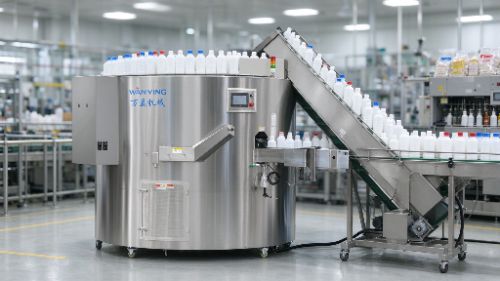
Even the most advanced filling line grinds to a halt the moment bottles stop arriving in the right orientation. That single point of failure is why unscramblers deserve far more attention than they usually get. Wanying Machinery builds bottle unscrambler solutions around a simple idea: speed means nothing without steady, dependable bottle flow. In this article, we look at the design choices, common bottlenecks, and practical upgrades that keep packaging lines moving instead of waiting.
What Actually Happens When Bottles Hit the Unscrambler Flipped
The collision is less about pushing bottles upright and more about using their own momentum against them. A bottle coming off the feed usually enters the flipping zone at a slight angle, and the curved rail or strike plate catches the base or shoulder just enough to create a pivot. Because the base is often heavier or shaped differently than the neck, the bottle does not simply slide away; it rotates around the contact point and lands on the next conveyor with a new orientation.
Speed matters here more than most operators expect. If the incoming speed is too high, bottles rebound off the rail and start tumbling, which leads to jams at the exit. If the speed drops too low, the bottle makes contact but never completes the turn, leaving it sideways or wedged against the guide. The flash of movement at the flip point hides a narrow window where bottle weight, rail curvature, and belt speed all have to line up.
Adjusting the mechanism usually means changing the strike angle or the height of the pivot edge rather than adding force. A small shift in that edge changes where the bottle rotates, which alters the final drop point more than the spin itself. That is why a machine that looks violent is actually quite sensitive, and why scratched bottle shoulders or tiny scuffs near the neck ring often trace back to one misaligned guide rather than rough handling.
Why the Fastest Unscrambler Setting Rarely Helps the Filler
Most people open the fastest unscrambler mode expecting a shortcut, but that speed quietly undermines what a filler actually needs. The setting is tuned to return one high-confidence rearrangement, not to surface the broader set of words that might fit the surrounding context.
A filler is usually balancing tone, rhythm, and length, so losing the lower-frequency or oddly inflected options matters more than it seems. The fastest path skips those rough candidates precisely because they are not the most common matches, yet they are often the ones that prevent a sentence from sounding forced.
There is also the issue of feedback. When the tool pushes a single answer right away, you stop comparing alternatives, and that makes the whole process feel faster but less useful. Filling gaps well tends to require a slower scan of possibilities, not just the first result the engine can produce.
Changeover Adjustments That Take Minutes Instead of an Hour
A lot of changeover time gets written off as fine-tuning, but that hour usually breaks down into a dozen small corrections. A guide rail drifts a few millimeters after cleaning, a sensor bracket gets bumped during teardown, and a fill head no longer lines up with the new bottle neck. Adding witness marks, dowel pins, and hard stops turns those corrections into repeatable positions. The adjustment doesn't disappear, but it becomes a quick visual check instead of trial and error.
The bigger win comes from tracking what actually gets adjusted every time. When operators log a changeover and note the same two settings being tweaked, that's a signal something is still too loose or too vague. One packaging line cut its worst format change from fifty-eight minutes to just under nine by replacing slotted brackets with fixed spacers and putting torque marks on the few bolts that do need to move. The remaining adjustments are now measured in seconds because there are fewer decisions left to make by hand.
How Bottle Resin and Wall Thickness Shift Unscrambler Behavior
A bottle's resin does more than determine clarity or chemical resistance; it changes how the container moves through an unscrambler. PET tends to produce a stiff, lightweight shell that slides rapidly along stainless steel guides, but it also picks up static in dry air and may cling at the worst possible moment. HDPE and PP feel waxier and flex more, which can make them quieter in the bowl but more prone to catching on worn rails or failing to release cleanly from a pocket.
Wall thickness alters that behavior further. Thin-wall bottles often bounce after leaving a drop chute, land slightly off-center, and then need extra settling time before the takeaway starwheel grabs them. A heavier, thicker preform or bottle rights itself more predictably, yet it may respond sluggishly to air jets and put more load on the bowl drive. When wall distribution is uneven, the bottle can lean into the grippers or present itself at a slight angle, turning a minor thickness change into a recurring jam.
Operators usually notice the shift as a mismatch between old settings and new containers. Adjusting only line speed rarely fixes the issue; pocket geometry, rail width, air pressure, and drop height all interact with the bottle's weight and flex. Because resin and wall thickness influence friction, rebound, and static buildup at the same time, even a small material change can require retuning the unscrambler as a system rather than tweaking a single station.
The Infeed Detail That Prevents Most Exit Jams
Most people blame exit jams on downstream speed or sensor placement, but the real trouble usually starts much earlier. At the infeed, inconsistent spacing between cartons or oversize items entering side by side sets off a chain reaction that leaves no room to merge cleanly at the discharge.
A small adjustment to the infeed guide rail or timing belt often does more than any exit-side fix. Keeping product centered and releasing it only when the downstream zone is clear gives each package a defined path, so the exit never has to absorb a sudden pile-up.
Once that spacing discipline is locked in, the rest of the line stops fighting itself. Operators notice fewer manual clearances and less wear on diverters, simply because product arrives at the exit at a rhythm the system can handle.
When Slower Discharge Speeds Keep the Whole Line Moving
On a busy packaging line, the instinct is often to speed up every discharge point. That extra burst from a hopper or chute can look productive for a few minutes, but it rarely lasts. Product piles up at the next transfer, sensors fault, and someone has to clear a jam. Slowing the discharge just enough to match the downstream equipment changes that pattern. The line may appear less aggressive, yet it keeps moving instead of lurching between surges and stops.
The real advantage shows up in rhythm. When discharge speed is tuned to the actual takeaway rate, small variations in carton spacing or belt speed get absorbed before they become blockages. Operators stop chasing alarms and start noticing the line's natural pace. In many cases, a ten or fifteen percent reduction at the discharge creates longer uninterrupted runs than running the same point at full speed.
This approach also reduces wear. Constant stops and restarts put far more stress on motors, guides, and sensors than a steady, slightly slower flow. Once the discharge speed is set to protect the bottleneck rather than feed it, throughput often improves without adding equipment. The line moves because nothing is being forced faster than the next step can handle.
FAQ
Because they deal with the messiest part of the process: a bulk pile of bottles that need to be separated, oriented, and released at a steady rate. If bowl speed, air nozzles, and exit timing are not matched to the bottle shape, the upstream equipment outpaces the unscrambler, and small jams quickly turn into frequent stops.
Most jams come from bottles reaching the transfer point at the wrong angle, static buildup on PET surfaces, or guide rails that have shifted slightly after hours of vibration. Cleaning the sensors and checking rail alignment usually clears more jams than changing the bowl speed.
Focus on how the bottle behaves when it moves, not just its dimensions. Top-heavy or square bottles need different bowl profiles and rail adjustments. Ask the supplier to run a sample batch at your target speed and count how many bottles exit in the wrong orientation.
Look for quick-release rails, numbered or notched adjustment points, and saved recipes that move the bowl and tracks into position automatically. Even simple color-coded guides help operators make repeatable size changes without trial and error.
Wipe down sensors and photoeyes at the start of each shift, check belt tension, remove dust from the drive area, and inspect guide rails for sharp edges. Small misalignments show up first and become major failures only when they are ignored.
It can, but recycled PET varies in thickness and static behavior. Adjustable air assist, forgiving bowl geometry, and well-maintained rails handle most of that variation, especially if incoming bottles are pre-sorted before reaching the unscrambler.
Watch for reduced oriented bottle output, repeated sensor faults, new rattling, or bottles backing up at the exit. These are early signs that a rail has moved, a sensor is dirty, or a drive part is wearing.
Start with the drive system: worn belts, loose guards, and misaligned pulleys add unnecessary noise. Replacing those parts, adding mounting pads, and using low-noise motors often cut sound levels without large enclosures.
Conclusion
Most bottle unscrambler issues on a packaging line start long before the filler sees an empty gap. When a bottle lands flipped in the orienting bowl or pockets, operators often respond by pushing the unscrambler to its fastest setting, but that usually makes things worse. Higher speed leaves less time for the bottle to settle correctly, so misoriented containers get rejected or jammed instead of feeding smoothly. Matching the unscrambler's discharge to the filler's actual demand, even if it means running a slower bowl speed, tends to keep the whole line more stable. Small infeed adjustments also help: guiding bottles into the unscrambler in a single layer without crowding prevents most exit jams that would otherwise stop the filler.
Material differences play a bigger role than they first appear. Bottles with thinner walls, recycled resin, or a slightly tacky surface do not slide or rotate the same way as virgin PET with a heavier sidewall, so a setting that works for one bottle style can create misfeeds or wedging with another. Changeover should focus on a few key points—rail height, pocket depth, and air jet timing—rather than a full hour of trial and error. Once those are set to suit the bottle profile, the unscrambler tends to hold a steady rhythm, and the line does not have to fight constant stops and restarts.
Contact Us
Contact Person: Tyson
Email: [email protected]
Tel/WhatsApp: +8613396971296
Website: https://www.wanyingmachinery.com