

Copper-Nickel-Chrome Barrel Plating Equipment Exporter: What Sets Top Suppliers Apart
2026-09-10
When sourcing copper-nickel-chrome barrel plating equipment, the gap between a supplier that just ships machines and one that keeps your plating line profitable is rarely obvious on a spec sheet. Top exporters separate themselves through barrel design, current distribution, and the kind of service response that prevents costly downtime. Junda has built its name on those less glamorous but decisive details—here’s what to watch for before you sign a contract.
Barrel Geometry That Stops Small Parts from Wedging and Burning
Small parts often tumble into tight spots inside a vibratory bowl, where they wedge against corners or get scorched by repeated friction. The barrel geometry here breaks that cycle by redirecting parts away from pinch points before they can settle. Instead of a continuous curve that encourages nesting, the profile uses stepped radii and a slightly tapered wall to keep parts moving in a loose, rolling stream. This prevents the localized heat buildup that leaves burn marks on delicate edges.
The real difference comes from how the barrel cross-section manages contact pressure. A conventional bowl lets parts lean against one another during the feed cycle, especially around the outer track. In this design, the inner wall drops away at a steeper angle just after the carry point, so parts lose surface contact earlier and slide back into the main mass. That brief separation is enough to stop micro-welding and abrasive scorching caused by static friction.
Field adjustments also become less critical. Because the geometry itself discourages wedging, operators don't have to tune the bowl amplitude as aggressively or add extra coating to prevent burns. The parts simply ride the contour without getting trapped in dead zones. For high-volume runs of tiny plastic or metal components, that means fewer rejects from cosmetic heat damage and less downtime spent clearing jams.
Why Uniform Copper Flash Comes Down to Rectifier Response, Not Just Chemistry
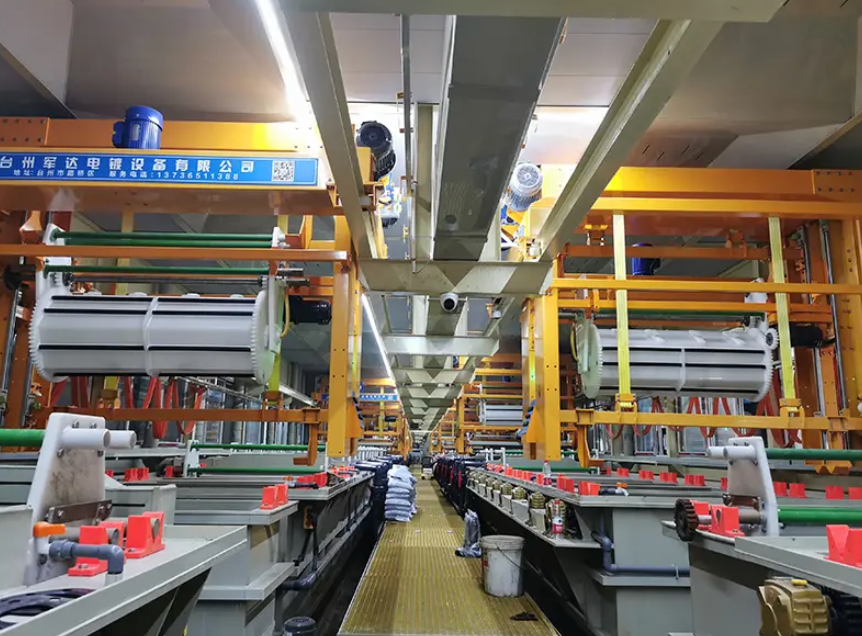
When a plater sees uneven copper flash across a panel, the first instinct is often to adjust the bath—more brightener, a different carrier, maybe tweak the acid ratio. But real-world line data keeps pointing back to the power supply. A rectifier that can't deliver a fast, stable current response will create thickness variation even with a perfectly balanced chemistry. The copper ions don't decide where they deposit; the local current density does, and that's governed entirely by how the rectifier reacts to load changes, surface resistance, and part geometry.
Consider a rack entering the bath. The initial current surge and the way the rectifier settles to its setpoint determine how evenly the first few microns of copper lay down. If the response is sluggish or the ripple is high, high-current-density zones—edges, holes, raised features—grab more than their share of copper before the field evens out. A rectifier with tight regulation and low ripple keeps the driving force uniform from millisecond to millisecond, so the deposit builds at the same rate across the entire surface. Chemistry can only set the stage; it can't compensate for a power source that hesitates or overshoots.
That's why many plating lines have stopped chasing exotic chemical fixes and started auditing rectifier performance instead. Voltage and current waveforms under actual load, response time to step changes, and ripple percentage at operating current often explain more about thickness distribution than any bath parameter. Once the rectifier responds cleanly and quickly, even a standard acid copper bath can produce a remarkably uniform flash. The chemistry matters, but only after the electrical foundation is right.
Nickel and Chrome Thickness Claims Worth Testing Before You Import
Suppliers often list impressive nickel and chrome thickness on spec sheets, but those numbers can drift once production ramps up. A layer that's too thin may look fine at first, then start showing pitting, rust, or flaking within months of use. If you're importing components for automotive, plumbing, or outdoor hardware, the cost of a failed plating job goes far beyond a replacement order—it can tarnish your own brand.
Rather than accepting the claim at face value, ask for plating thickness tests from the actual production batch, not a golden sample. X-ray fluorescence (XRF) is fast and non-destructive, but it measures only the top layer; for a true cross-check, coulometric testing or cross-section microscopy gives you the exact nickel and chrome buildup. Pay special attention to recessed areas and edges, where thickness often drops below the stated average.
Before you commit to a full container, establish clear acceptance criteria: minimum thickness at defined measurement points, allowable variation, and test method. A third-party inspection that includes plating verification can catch discrepancies early, saving you from clearing customs with a load of parts that will fail in the field. It's a small upfront step that prevents a much larger headache later.
The Frame and Lining Materials That Survive Daily Acid Exposure
Every bag destined for acid-heavy environments starts with a quiet war between chemistry and construction. The frame rarely gets the credit it deserves—until a cheaper alloy starts pitting after three weeks of incidental splashes. Marine-grade 316 stainless steel earns its keep here, not because it's exotic, but because its molybdenum content shrugs off chlorides and sulfuric traces that would eat through lesser metals. Weld points matter as much as the alloy itself: a continuous bead without micro-fissures prevents capillary action from wicking corrosive droplets into the frame's hollow sections.
Linings tell a more tactile story. Polypropylene homopolymer sheets, thermally bonded rather than glued, handle the daily drip of citric and acetic acids without delaminating—a common failure when adhesives soften under chemical attack. For harsher exposure, PTFE-coated fiberglass offers a slick, inert barrier, though its cost pushes it toward niche applications. The real trick is choosing a lining that flexes with the frame's thermal expansion instead of cracking at the corners, which is where most linings quietly surrender.
Then there's the overlooked hero: the gasket channel. EPDM rubber, not generic neoprene, holds its elasticity after repeated contact with dilute hydrochloric acid. Pair that with a compression latch that maintains even pressure across the lid, and you buy years of service with a part most buyers never inspect until the first leak. Survival isn't about a single bulletproof material—it's about matching each component to the specific acid it's likely to meet, then testing the assembly as a whole rather than trusting vendor spec sheets.
Shipping and Handling Steps That Keep Plating Barrels Aligned and True
Before a plating barrel leaves the shop floor, it gets a set of hardwood cradle blocks cut to the drum's exact diameter. These aren't generic pallets—each barrel has its own pair, with shallow grooves that let the cylinder sit without any side pressure on the gear rings. We bolt the cradles to a steel skid, then strap the barrel down with polyester webbing at four points. The trick is to tension the straps just enough to stop rotation, never so tight that the shell distorts. A quick check with a dial indicator on the trunnion journals confirms runout is under 0.010 inch before the crate lid goes on.
During transport, the barrel should always ride with its axis horizontal and parallel to the trailer floor. Standing a barrel on end, even for a short hop, invites the internal anode bar or dangler arm to shift and knock the centerline out. We mark each skid with a red dot on the side that faces the forklift, so the operator never has to guess which edge can take the forks without touching the barrel body. For long hauls, adding a layer of closed-cell foam between the straps and the barrel surface stops road vibration from wearing flat spots into the polypropylene or titanium shell.
Once the barrel arrives, don't rush the unboxing. Let the crate sit in the plating room for a full shift so the barrel reaches ambient temperature and any condensation evaporates from the journals. Then use a laser alignment tool to compare the barrel's gear ring plane against the saddle blocks on the plating line. If the readings are off by more than a couple thousandths, you can shim the saddle rather than forcing the barrel into place. That extra ten minutes of measurement beats replacing a cracked hub or a bent dangler arm three weeks later.
How Top Exporters Prove Their Line Works Before It Reaches Your Plant
Top exporters don’t ask you to take their word for it. Before a line leaves their facility, they run it under conditions that mirror your own production environment—actual materials, real cycle times, and the same operator movements that will happen on your floor. This isn’t a quick dry cycle or a jogged conveyor. It’s a full trial, often filmed and timestamped, with samples pulled and measured against agreed tolerances. If a sensor reads slow or a guard trips, it gets corrected there, not after the containers arrive.
The proof usually comes in three parts. First, a Factory Acceptance Test where your team can attend in person or via live video. Second, a documented pre-shipment inspection that checks every critical point—torque settings, weld integrity, control system response. Third, a complete packaging report showing how the line was dismantled, labeled, and protected for transport. Any exporter serious about their reputation will hand over these records without hesitation.
One detail separates the best: they simulate not just normal operation but also the edge cases. They’ll introduce a misaligned container or a sudden power cut to confirm the line stops safely and recovers without damage. That’s the kind of testing that doesn’t show up in brochures, but it’s exactly what prevents costly downtime once the equipment is reassembled in your plant.
FAQ
They rarely start with the brochure. Most will ask for a detailed process flow diagram, then follow that with questions about tank wall thickness, rectifier headroom, and whether the barrels have replaceable dangler contacts. A supplier who can explain why they chose a specific perforation pattern for copper strike versus chrome usually knows the line better than one who only quotes dimensions.
The barrel itself is often the culprit. Poorly placed holes, a weak cathode connection, or an incorrect rotation speed can create dead zones where solution exchange suffers. Top exporters design barrels with perforation ratios above 20 percent, use heavy-duty danglers that maintain contact at every angle, and test rotation settings against real part loads before shipping.
Modular construction lets a shop bring in pre-assembled sections, bolt them together, and start wiring instead of hiring welders on site for weeks. Later, if production rises, adding another nickel or chrome station means ordering one more module rather than rebuilding a welded structure. It shortens downtime and keeps future expansion costs predictable.
Beyond a warranty card, serious exporters provide remote fault diagnosis, startup supervision, operator training, and a clear list of critical spare parts. Some also stay involved with process support, helping adjust current density or barrel loading when a new part geometry causes roughness or burning. That ongoing technical backup often matters more than a small price difference at purchase.
Yes, if they ask the right questions. For example, ask how the supplier sequences copper strike, semi-bright nickel, bright nickel, and chrome rinses to avoid cross-contamination. A strong supplier will talk about drag-out control, dedicated flight bars, and rectifier ramp times. A weak one will only mention tank sizes and heating power.
Because current stability controls the entire deposit structure. Ripple above five percent can cause stress and poor adhesion in chrome, while insufficient current headroom limits barrel loading density. Reputable exporters match rectifier output to barrel surface area, specify low ripple for chrome, and include current interruption or pulse options where needed.
Often yes, but not because of the equipment alone. A turnkey supplier takes responsibility for tank layout, ventilation, water treatment tie-ins, and electrical installation. That single-point accountability reduces the risk of finger-pointing when something leaks or a rectifier faults. For a busy plating shop, avoiding even a few weeks of delayed startup can cover the price premium.
Safety and electrical standards matter most: CE marking, ISO 9001 for manufacturing consistency, and IEC 60204 for machine electrical systems. Beyond certificates, ask for a recent export reference with similar barrel sizes and a written commissioning checklist. A real exporter will share both without hesitation.
Conclusion
What separates a genuinely reliable copper-nickel-chrome barrel plating equipment exporter is rarely the catalogue spec sheet—it’s the quiet engineering work behind the barrel itself. Leading suppliers reshape perforation angles and add shallow internal dams so tiny fasteners and sleeve-like parts tumble without wedging into corners or burning from uneven current density. They treat rectifier response as part of the process, tuning ripple and ramp times so the initial copper flash lays down evenly before nickel or chrome ever meets the part. Rather than trusting a glossy brochure, experienced buyers ask for x-ray fluorescence readings on test coupons from several zones of the barrel, because nickel and chrome thickness claims collapse quickly when measured at the bottom of a loaded basket. The frame and lining choices—thick stress-relieved polypropylene, PVDF around anode areas, stainless steel saddles that resist chloride pitting—are what let the line survive daily acid mist and hot rinse cycles without warping or cracking.
Top exporters also take responsibility for what happens after the equipment leaves their floor. They machine barrel journals to tight concentricity, then brace the complete assembly inside a steel-framed crate with vibration-damping pads so shipping doesn't pull the cylinder out of true. Instead of making you guess, they run a full pilot batch on your own sample parts with your approximate bath chemistry, record amp-hour curves, measure thickness distribution and adhesion, and send the plated parts along with the video before the container is sealed. That pre-delivery proof—not a generic test report—is what lets a plating line start up in days instead of weeks, because the supplier has already dialed in the barrel speed, rectifier settings, and load pattern for the parts you actually run.
Contact Us
Contact Person: hayyr
Email: [email protected]
Tel/WhatsApp: 8613082110525
Website: https://www.jundaelectroplating.com