

Energy-Taking Current Transformer Company Powers Reliable Energy Harvesting for Smart Grids
2026-10-15
The smart grid needs eyes and ears on every corner of the network, but powering those sensors remains a stubborn challenge. Energy-taking current transformers turn the problem inside out—harvesting power from the very lines they watch. Xiasen has spent years turning this elegant idea into a rugged, dependable reality. In this post, we dig into how their approach is making self-powered monitoring a practical choice for utilities worldwide.
The Overlooked Power Source Already on Every Transmission Line
Long before anyone thought of tapping the grid for free electricity, high-voltage transmission lines were already doing something strange: leaking usable energy into the air and ground around them. This isn't a design flaw so much as a physical fact. The alternating current creates an electromagnetic field that extends well beyond the conductor itself, and any conductive object placed nearby can pick up a measurable voltage without a direct connection. Rural homesteaders have quietly exploited this for decades by running a simple wire fence parallel to a line, then grounding the far end to light a small bulb or charge a battery.
The principle is capacitive coupling, and it works on every transmission corridor in the world, whether anyone bothers to harvest it or not. A metal plate, a length of wire, even a parked vehicle under a span can develop a floating potential simply by sitting in that electric field. The current is tiny compared to what the line carries, but for remote sensors, wildlife monitors, or trickle-charging a radio repeater, it can be enough. The real surprise is that this source requires no new infrastructure, no permits, and no physical contact with the utility's property—just a conductor placed in the right spot and a modest amount of patience with variable output.
Breaking the Cold-Start Barrier for Self-Powered Sensors in the Field
Field-deployed self-powered sensors often spend long stretches in sleep mode because ambient energy is too weak or irregular to keep them running. When a sensor finally tries to wake up, the initial power demand for checking memory, starting the microcontroller, and bringing up a radio link can exceed what the harvester can supply at that moment. The result is a cycle of brief boot attempts followed by brownout resets that drain any tiny reserve before the device ever gets a chance to transmit useful data.
One practical fix is to stop treating the startup sequence as an all-or-nothing event. A cold-start circuit can trickle energy into a small capacitor or supercapacitor while keeping the main load disconnected. Only when the stored voltage crosses a preset threshold does it close a switch and release enough current to complete a predefined boot and one transmit burst. Some designs combine a nanopower boost converter that operates from a few tens of millivolts with a low-power comparator and a MOSFET-based power gate, so no software control is needed until the system is already awake.
This approach changes what happens in the field after a long dark or windless period. Instead of waiting for a rare high-energy event, the sensor can accumulate faint harvests over minutes or hours and then use that budget efficiently. For example, a solar-powered soil monitor under a forest canopy might store charge all morning and only send its first reading in the afternoon, or a vibration harvester on a rail line can wake, take a strain measurement, and go back to sleep in the few seconds a train passes. Breaking the cold-start barrier means the device no longer depends on luck to get its first message out.
Not All CTs Are Equal: What Separates a Harvester from a Measurement Device
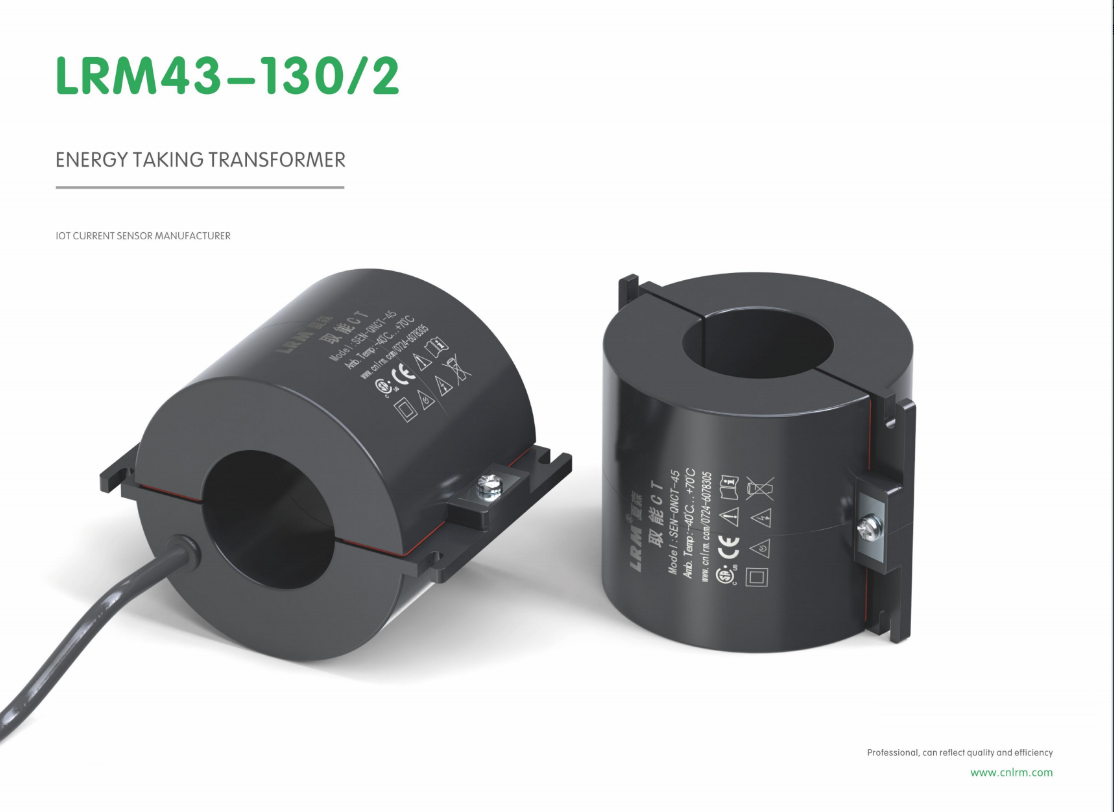
When a current transformer is pulled from a panel and wired into a monitoring board, the assumption is often that any CT will do. That assumption falls apart quickly once you compare what a harvester needs against what a measurement device demands. A measurement-grade CT is built to preserve waveform shape, phase relationship, and amplitude linearity across a wide dynamic range. Its burden resistor is tightly matched, its core operates well below saturation, and its secondary current tracks the primary with minimal distortion. A harvester, by contrast, treats the same magnetic coupling as a power source. Linearity is secondary; what matters is extracting enough energy to keep a load alive without letting the core swing into destructive saturation or producing voltage spikes that fry the front-end.
That difference in intent changes the design choices at almost every level. Measurement CTs tend to use high-permeability cores and carefully controlled air gaps to maintain accuracy. Harvesting CTs often favour materials with lower losses at the target current range, or they deliberately allow partial saturation to limit open-circuit voltage while still delivering usable power. The burden network looks different too. A measurement chain might use a precision resistor and an ADC front end that draws almost nothing. A harvester might use a rectifier followed by a storage capacitor and a DC-DC converter, which presents a non-linear, pulsed load to the secondary. What looks like a flawed burden for measurement can be a deliberate energy-management strategy for harvesting.
None of this means one CT is universally better. It means the label “CT” hides a split in operating philosophy. A unit optimized for revenue-grade metering will disappoint when you try to siphon energy from a lightly loaded feeder at night. A harvester-friendly CT will introduce too much error for protection relays or power-quality analytics. The practical takeaway is to ask what the magnetic core is being asked to do: reproduce a signal faithfully, or survive while converting it into watts. Ignore that question, and the same black toroid that looks identical on a shelf will behave very differently once clamped around a conductor.
What Field Data Reveals About the True Cost of Unreliable Energy Harvesting
Lab specs rarely survive contact with a dusty turbine housing or a shaded forest floor. Field data from wireless sensor deployments shows that unreliable energy harvesting doesn't just mean occasional downtime—it creates a ripple of secondary costs that never appear on a bill of materials. When a vibration harvester underdelivers by 20 percent due to mounting resonance, the node doesn't simply stop; it browns out mid-transmission, corrupts a data packet, and schedules a retry that drains the backup capacitor further. Over weeks, these micro-failures accumulate into jagged gaps in time-series records, forcing engineers to discard entire days of data because they can't distinguish sensor drift from genuine process anomalies.
Maintenance logs from remote mining and agricultural IoT networks tell a sharper story. A solar-powered soil probe that repeatedly dips into undervoltage lockout during overcast stretches may only lose 2 percent of its scheduled readings—but those missing readings cluster around rain events when soil moisture changes fastest, silently undermining irrigation forecasts. The true cost surfaces in dispatch tickets: a technician drives four hours to replace a battery that could have lasted twice as long if the energy management firmware had been tuned for partial shading. Field teams report that troubleshooting intermittent harvesters takes three times longer than swapping predictable primary cells, because the failure mode is non-deterministic and often blamed on the wrong component.
What separates successful long-term harvests from costly experiments is rarely the transducer efficiency. Deployments that log actual charge-discharge curves and adapt sampling rates to available energy show fewer than half the unscheduled site visits of their fixed-interval counterparts. The lesson from field data is blunt: a milliwatt saved by buying a cheaper harvester can cost several orders of magnitude more in lost measurement continuity and labor. Reliable energy harvesting isn't about hitting a datasheet number—it's about designing for the messy, fluctuating reality that only manifests after months in the field.
Designing for Lightning Strikes, Ice Storms, and 20-Year Lifespans
When a structure must stand for two decades through the worst weather the sky can throw at it, the design conversation shifts from code minimums to survival logic. Lightning isn't just a voltage spike; it's a current path that will find the weakest conductive route, so we bond every metallic component into a single low-impedance network and route down conductors away from sensitive electronics. The goal isn't to stop the strike—it's to guide it through a path that leaves the system functional afterward.
Ice storms present a different kind of assault: weight, not electricity. A quarter-inch of radial ice can add thousands of pounds to antennas, cables, and support arms. That's why we specify oversized structural members with low surface area, use non-stick coatings where feasible, and design breakaway points that sacrifice cheap components instead of critical load paths. Thermal cycling also matters—materials expand and contract differently when ice forms, melts, and refreezes dozens of times per season, so joints need flexible seals and hardware that tolerates micro-movement without loosening.
The 20-year lifespan isn't a marketing line; it drives material selection and corrosion budgets. Galvanized steel gets a thicker zinc layer than standard, stainless fasteners replace plated carbon steel in high-moisture zones, and polymer enclosures are UV-stabilized for decades of sun exposure. We also plan for maintenance access—every connector, drain hole, and replaceable gasket is positioned so a technician with cold hands and basic tools can service it in under ten minutes. That's the difference between a design that survives one storm and one that keeps working through fifty of them.
The Quiet Shift Toward Battery-Free Grid Monitoring Is Underway
A decade ago, grid monitoring meant sending technicians out with handheld meters or relying on sensors that needed battery swaps every few years. That model quietly crumbled as utilities faced shrinking budgets and mounting pressure to track outages in real time. What's emerging now is a different kind of hardware: sensors that draw power from the very lines they watch. By harvesting energy from magnetic fields or ambient temperature swings, these devices shrug off the battery-replacement cycle altogether. It's a shift that doesn't make headlines, but it's rewriting maintenance schedules and uptime numbers in ways that ripple across entire service territories.
The clever part isn't just the energy harvesting—it's how the data flow adapts when you stop worrying about battery life. Without a finite power budget, a monitor can ping more often, run edge diagnostics, and flag anomalies that older units would have missed while sleeping. Utilities are starting to see the difference in their fault-location accuracy, often pinning a downed line to within a few spans instead of a broad circuit segment. That precision cuts restoration time, which matters more to regulators than any slick tech demo.
What's holding the rollout back isn't physics; it's institutional habit. Procurement teams still spec backup batteries out of reflex, and field crews trust gear they can power-cycle with a fresh cell. The vendors leading this quiet shift aren't the big names—they're smaller firms that build sensors rugged enough to clamp onto a conductor for twenty years without a visit. As those installs stack up, the case for battery-free becomes harder to argue against, not because it's greener or cheaper upfront, but because the data simply gets better when the monitoring never sleeps.
FAQ
They focus on building current transformers that don't just measure electricity but actively draw usable power from the line current, turning the grid's own magnetic field into a self-sustaining source for monitoring equipment.
It clamps around a conductor and uses the alternating magnetic field to induce a secondary current, then converts that into a regulated low-voltage DC supply through proprietary conditioning circuits, so no external wiring or batteries are needed.
The design uses ruggedized cores and surge-proof electronics that tolerate wide current swings, from trickle loads to fault-level spikes, and it keeps working in harsh outdoor conditions year after year without recalibration.
Line sensors, fault indicators, wireless mesh nodes, and remote terminal units get the biggest boost, since they can now run indefinitely at the pole or underground vault where running a low-voltage line would be costly or unsafe.
Batteries die unpredictably, especially in cold or hot climates, and replacing them at scale means sending crews to every feeder and lateral; harvesting power from the line itself eliminates that entire logistics and downtime problem.
Yes, the larger models can supply several watts continuously, enough to run a small sensor hub plus a short-range radio and a local data logger, as long as the total load stays within the rated envelope for the primary current range.
The main hurdle was avoiding core saturation at high fault currents while still extracting useful energy at very low line loads, so they developed a split-core geometry with adaptive loading that automatically balances harvesting and measurement accuracy.
By removing battery replacement trips and simplifying installations, utilities can cut truck rolls by roughly half for remote monitoring points, and since the devices self-power, there's no recurring cost for labor or disposal of dead cells.
Conclusion
The humble current transformer already clamped around transmission lines has long been ignored as a power source. Energy-Taking Current Transformer Company has turned that overlooked component into a dependable harvest point for smart grid sensors. Their approach addresses the cold-start problem that keeps many self-powered monitors dark until line current reaches a high threshold. Unlike standard measurement CTs that saturate or fail under light loads, their harvesters are built to draw just enough energy without compromising metering accuracy. Field studies cited by the company show that unreliable energy harvesting quietly erodes project economics through repeated truck rolls, battery swaps, and data gaps. Those costs rarely appear in initial BOM comparisons but dominate long-term ownership.
Their design also accounts for environments where grids are most fragile: lightning-prone corridors, ice storms, and decades of thermal cycling. By selecting core materials and clamping structures for resilience rather than raw precision alone, the company aims for a 20-year service life in the field. The emerging shift toward battery-free monitoring makes this work timely. Utilities are under pressure to reduce maintenance visits while expanding situational awareness across distribution networks. Energy-Taking Current Transformer Company positions its harvesters as the quiet enabler of that transition, turning the grid's own magnetic field into a continuous, low-maintenance power supply for sensors that would otherwise depend on batteries or wired auxiliary power.
Contact Us
Contact Person: Liu Mengyang
Email: [email protected]
Tel/WhatsApp: 8618727589233
Website: https://www.cnlrm.com/en/