

Export Sandwich Panels: A Complete Buyer’s Guide for Global Projects
2026-11-16
Every year, thousands of sandwich panels get ordered for global projects with little more than a drawing and a price. Then reality hits: coating chips, cores soak up moisture, or the container arrives with edges that look like they went through a blender. This guide strips away the guesswork from exporting sandwich panels—covering specifications, certifications, and shipping details that actually matter across borders. Drawing on real-world lessons from LANYUN, it's designed to help you ask the right questions before you commit.
Core Material Trade-offs That Determine Fire Safety and Thermal Efficiency
Every sandwich panel hinges on a fundamental compromise: the core material that locks in thermal resistance rarely excels at resisting flame spread. Organic foams like polyurethane and polystyrene deliver impressively low thermal conductivity, often below 0.025 W/m·K, which keeps insulation slim and efficient. Yet those same hydrocarbon chains ignite readily and can release dense, toxic smoke when exposed to fire. On the opposite end, mineral wool and perlite-based cores shrug off high temperatures and earn top Euroclass ratings, but their higher density and modest insulating power force designers to accept thicker panels or reduced energy performance.
Look closer at specific chemistries and the trade-off sharpens. Polyisocyanurate (PIR) improves on standard polyurethane by forming a char layer that slows combustion, pushing it toward a B-s1,d0 classification while holding thermal conductivity near 0.022 W/m·K. Phenolic foam goes further on fire safety, reaching B-s1,d0 with extremely low smoke, but it suffers from brittleness and moisture sensitivity that complicate long-term thermal stability. Meanwhile, expanded polystyrene (EPS) offers cheap, stable insulation at roughly 0.032 W/m·K, but without fire retardants it melts and drips, spreading flames rapidly. Choosing a core therefore means ranking priorities: whether a few extra millimetres of thickness or a slightly higher U-value is worth the jump from a material that burns with difficulty to one that barely burns at all.
What International Building Approvals Actually Require for Sandwich Panels
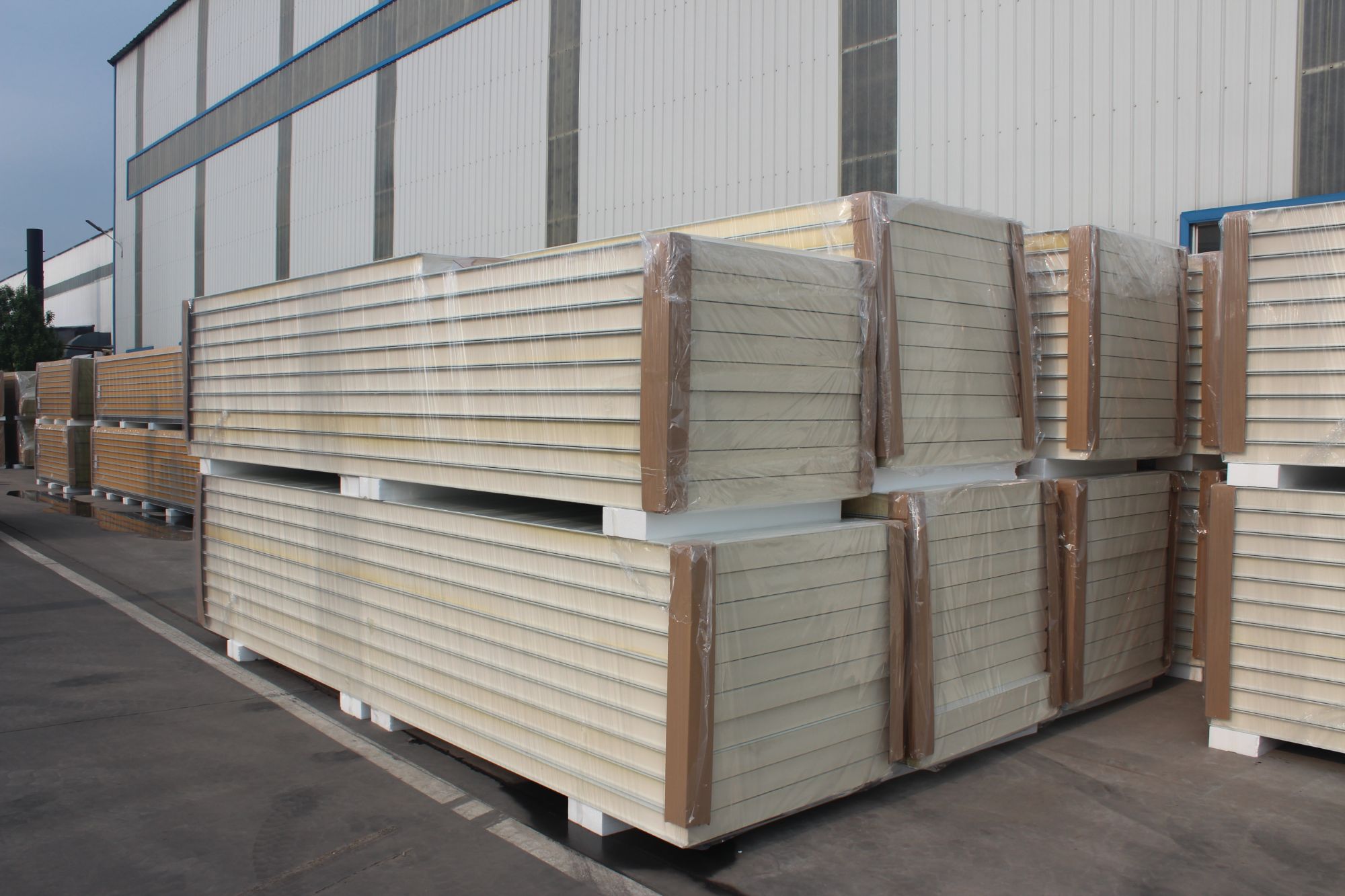
Most approval bodies don't treat sandwich panels as a single product category. Instead, they evaluate the metal skins, the insulating core, and the joint system together, since a panel that passes a small-scale test can still behave very differently once it's installed in a continuous run. The first question is usually about reaction to fire: can the panel contribute to flame spread, smoke production, or burning droplets? That's why you'll see references to classification systems like EN 13501-1 in Europe or ASTM E84 in North America, but the classification alone rarely satisfies the reviewer. They want the full test report showing the exact assembly, including thickness, coatings, and any protective facings, because even changing the core density by a few kilograms per cubic metre can push a product from one Euroclass to another.
Beyond the material rating, some jurisdictions require large-scale or intermediate-scale fire testing for sandwich panels used in external walls or cold storage. Tests such as ISO 13785-2, FM 4880, or the now-withdrawn BS 8414 series (often replaced by local variants) look at how a panel system behaves when exposed to a realistic fire on one side of the wall. The critical issue isn't just whether the core burns; it's whether the fire can travel through the joint or delaminate the metal face, allowing flames to reach combustible insulation behind the panel. For this reason, many approvals demand that the core be non-combustible (mineral wool or certain foam glass) or that the panel include a fire barrier every certain distance, depending on building height and occupancy. Some authorities also limit the use of combustible-core panels in escape routes or high-hazard facilities unless a full engineering analysis is submitted.
Structural approvals add another layer. Since sandwich panels often act as both cladding and bracing, the approving engineer will ask for proof that the panel retains adequate strength at elevated temperatures and that its connections won't fail early in a fire. You may need test data on creep for foam cores under long-term load, wind uplift resistance with the specified fasteners, and reaction-to-fire performance after accelerated ageing. Insurance underwriters frequently impose stricter rules than the local building code, especially for food processing plants and warehouses where a small fire in a ceiling void can spread quickly. In practice, getting an international approval usually means assembling a dossier that combines third-party fire test reports, a detailed description of the installation system, and a statement from the manufacturer about batch-to-batch consistency. Without that documentation, even a panel with excellent fire ratings can be rejected at the permit stage.
Container Packing Methods That Prevent Damage on Long Sea Voyages
Long-haul ocean freight punishes poorly packed cargo. The first rule is to assume the container will roll, pitch, and shudder for weeks, so everything inside must be braced as if it will try to shift. Use wooden dunnage, air bags, and lashing bars to fill every gap; even a few centimeters of free space can turn a carton into a battering ram. Heavy items go on the bottom, liquid drums on end with bungs up, and pallets should be block-stacked rather than pyramided wherever possible.
Moisture is the silent destroyer on sea voyages. Containers sweat when they move through temperature swings, and condensation often drips from the roof onto the cargo. Line the floor and walls with kraft paper or desiccant mats, place silica gel or clay desiccant bags near the top and door, and never pack goods directly against bare metal. For goods that cannot tolerate humidity, use a ventilated container or add a moisture barrier such as shrink wrap with ventilation openings instead of sealing it tight.
Finally, secure the door area as if it will take the worst beating. The last row of cargo often bears the force of every wave because it has room to move forward. Install timber bracing across the door opening, use polyester strapping anchored to lashing rings, and mark the container with tilt indicators so handlers can see if it has been tipped. After closing, give the container a hard shake test with a forklift if possible; if anything shifts inside, it will shift a thousand times worse at sea.
Factory Capability Questions to Ask Before Signing a Supply Contract
Before you commit to a supplier, dig into the actual production floor. Ask how many lines they run, what their daily output looks like under normal conditions, and whether they have capacity to scale if your order volume doubles. Many factories will quote impressive numbers, but the real test is whether they can sustain that pace without sacrificing quality or pushing your order behind someone else's.
Equipment age and maintenance routines tell you more than a glossy brochure. Request details on their key machinery: how old is the primary injection molding machine? How often do they calibrate their CNC equipment? A factory running 20-year-old presses with no spare parts inventory is a supply chain risk waiting to happen. Also ask about their shift structure — do they run 24/5 or 24/7? If they only operate five days a week, lead times will stretch during peak seasons.
Finally, ask about their in-house capabilities versus what they outsource. If they claim to do plating, painting, or assembly on site, ask to see those workstations during your visit. A factory that subcontracts 40% of your project to unnamed third parties creates hidden quality and delivery variables. Get a clear list of their sub-suppliers, and verify whether those partners are audited for labor and material standards. This one question can save you from a contract full of unpleasant surprises.
When Custom Panel Dimensions Make More Sense Than Standard Sizes
Standard panel dimensions like 4x8 feet exist for a reason—they fit most framing layouts, keep manufacturing costs down, and simplify inventory. But once you run into a wall that's 9 feet 4 inches tall, or a ceiling pitch that shifts halfway across the room, those neat rectangles start demanding extra cuts, more seams, and a pile of offcuts you didn't plan for. Custom panel sizes step in when the space itself refuses to cooperate with off-the-shelf math. A good rule of thumb: if you're spending more time trimming and piecing than actually installing, the standard size is no longer saving you anything.
Waste reduction is another quiet advantage that rarely shows up on a spec sheet. Picture a long hallway with 30 feet of continuous wall—using standard 8-foot panels means five seams and five chances for misalignment. A custom-length panel can run the entire stretch in fewer pieces, giving you cleaner lines and less visible joint filler. This isn't about luxury; it's about matching material to reality. When the design calls for uninterrupted grain patterns, a specific reveal layout, or cladding that wraps around a curved surface, custom dimensions let the panel follow the intent instead of forcing the intent into a 4-foot grid.
There's also the practical matter of handling and installation. Custom panels aren't automatically heavier or harder to work with—sometimes they're lighter because they're cut to the exact height of a soffit or the width between two columns. You spend less time lifting, trimming, and recutting on site. The trade-off is lead time and cost, but if you've already budgeted for skilled labor, fewer field modifications often net out cheaper than the material savings from standard sheets. The decision really comes down to whether the project's geometry is doing the talking or you're still trying to make a square peg fit a sloped ceiling.
How to Cross-check Supplier Test Reports Against Real-world Conditions
Supplier test reports often read like polished marketing material, full of ideal lab settings and controlled variables that rarely survive contact with your actual setup. Start by pulling the raw data behind the headline numbers—request the full test methodology, not just the summary sheet. Look for specific parameters: temperature, humidity, load profile, duty cycle, and sample size. A battery rated for 80% capacity after 1,000 cycles at 25°C might degrade twice as fast when your warehouse sits at 35°C in summer. The real-world check begins with matching those lab conditions to your operational extremes, not the comfortable middle.
Next, run your own side-by-side validation on a small batch before committing to volume. Take three to five units from the same production lot that generated the supplier's report, then subject them to your actual usage pattern. If the report claims water resistance to IP67, don't just read the certificate—spray the units with your cleaning process or leave one in the rain for a week. Document every mismatch, no matter how small: a 3% efficiency drop under partial load, a louder-than-expected fan at 40°C, a connector that loosened after two weeks of vibration. These specific, observed deviations give you leverage in discussions and a realistic baseline for incoming inspection.
Finally, turn those one-off checks into a lightweight ongoing audit. Keep a small log that pairs each supplier claim with your field result, and update it quarterly. When the next batch arrives, spot-check against your own history rather than re-testing everything from scratch. Over time, you'll build a reliability profile per supplier that no glossy PDF can match—one grounded in your environment, your loads, and your failures. That's the data that actually tells you whether a test report was a promise or a prediction.
FAQ
In hot, humid climates, mineral wool often wins for moisture resistance because it doesn't retain water like EPS can, but PIR offers better thermal performance per inch. If you're building cold storage or need to meet strict fire codes, mineral wool with a high-density rating is safer. For standard industrial buildings, PIR with a closed-cell structure and proper edge sealing works fine. Always ask for humidity aging test data rather than relying on datasheet values.
Ask the supplier for structural calculation reports based on your project's specific wind speed and building height, not just a generic product certificate. Provide your local code references, like ASCE 7 in the US or Eurocode 1 in Europe, and request a panel span table that matches those criteria. A reliable manufacturer will run the numbers for you without extra charge. If they refuse or only give a brochure, walk away.
Beyond the panel cost, budget for edge trims, fasteners, sealants, and flashings—these can add 10-15% to the total. Freight is another big one: panels are bulky, so you're paying for volume rather than weight. Don't forget import duties, port handling, inland trucking, and possible crane rental at your site. Ask for a door-to-door cost breakdown early, and confirm whether the quoted price includes export packing, which prevents damage during transit.
Request a pre-shipment inspection by a third party like SGS or Bureau Veritas. Have them check panel thickness, metal skin gauge, core density, and adhesion strength against your purchase order. Ask for random samples from the production line, not hand-picked ones. Also verify the packaging: panels should be stacked on edge with protective film and corner guards. If the supplier pushes back on independent inspection, treat it as a red flag.
Ask for the certificate number and check it against the issuing body's online database. For CE marking, the Declaration of Performance (DoP) must list the exact product type and factory address. For fire ratings, look for test reports from labs like Exova, Warringtonfire, or Underwriters Laboratories. Call the lab to confirm the report is authentic and hasn't expired. Many fake certificates circulate, so never accept a photocopy without verification.
Look for a four-sided tongue-and-groove joint with a built-in gasket, not just a simple overlap. Cam-lock or hidden fastener systems create a tighter seal and reduce thermal bridging. If your project faces extreme rain, ask for panels with an anti-capillary groove on the side lap. Also check the sealant specification: butyl-based sealants hold up better than silicone in continuous wet conditions.
Most manufacturers need 3-5 weeks for production after drawing approval, then 2-6 weeks for ocean freight depending on the route. Custom colors or non-standard lengths can add 2-3 weeks. Don't forget port congestion and customs clearance, which can eat another week or two. Always build a buffer into your project schedule: order panels at least 10-12 weeks before you need them on site. Rush orders often mean corners get cut.
Yes, if the building is in a coastal or industrial area with high UV and salt exposure. PVDF (polyvinylidene fluoride) coatings keep their color and gloss far longer—often 20-30 years versus 10-15 for polyester. For interior walls or mild climates, standard polyester is adequate and saves money. Check the coating thickness: PVDF should be around 25-35 microns on the exterior side. Ask for a warranty in writing that covers chalking and fading.
Conclusion
Buying sandwich panels for export demands more than comparing thickness and price. The core material is where fire safety and thermal performance collide: mineral wool offers strong fire resistance but adds weight and can absorb moisture; PIR/PUR delivers lower thermal conductivity but raises questions about smoke and toxicity in some jurisdictions. International approvals seldom align perfectly—what passes in the Gulf may not satisfy EU or Southeast Asian codes, so request documentation that matches the destination country's specific standards rather than a generic "tested" claim. Container packing is just as critical; panels need edge protectors, proper dunnage, and sometimes vertical racking to survive weeks at sea without twisting or delaminating.
Before signing a supply contract, ask factory-specific questions: How many continuous lines run daily? What tolerance do they hold on flatness and length? Can they provide batch-level traceability from steel coil to finished panel? Custom dimensions often make sense when you're dealing with high-wind zones, unusual building geometries, or trying to minimize on-site cutting waste—but only if the factory has proven capability to switch profiles without compromising quality. Finally, cross-check supplier test reports against real-world conditions: a fire rating at 50mm thickness means little if your project uses 150mm panels, and a thermal conductivity figure from a 10°C mean temperature won't predict performance in a tropical or sub-zero climate. Ask for third-party reports done on the actual build-up, joint system, and installation orientation you plan to use. This kind of verification separates exporters who understand global projects from those simply selling sheets.
Contact Us
Contact Person: Nia
Email: [email protected]
Tel/WhatsApp: +86 18954360337
Website: https://www.sdppgi.com