

Top Solar Ground Mount Factory from China: Your Trusted Partner for Solar Mounting Structures
2026-09-02
Ground-mounted solar looks simple from a distance: rails, posts, clamps. But once wind loads, soil composition, and uneven terrain come into play, the cheapest factory quote rarely survives contact with the field. That's the gap Topfencesolar has spent years closing. As a China-based ground mount manufacturer, they focus on structural validation and field-ready design—details this post will break down before you commit to a supplier.
Inside Our Factory During a Typical Production Run
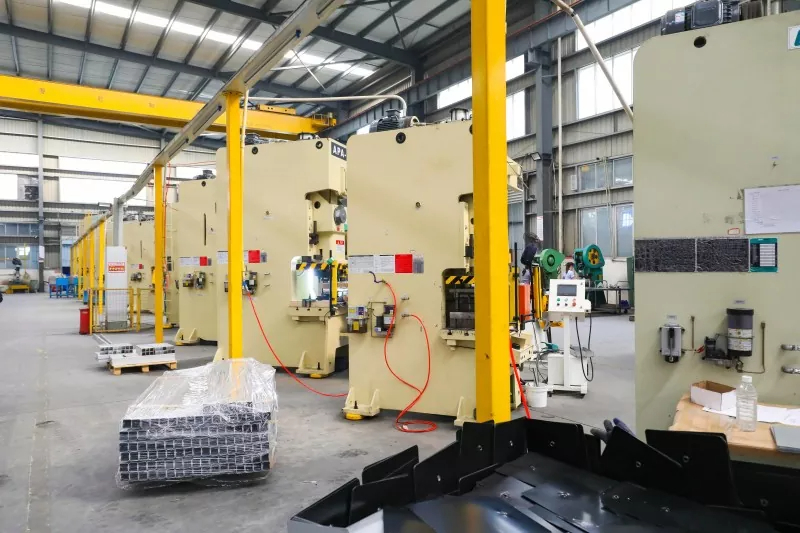
Walk onto the floor mid-run and you’ll catch every line moving with a rhythm that took years to refine. Raw sheets slide from the cutting tables into press stations, where operators run their fingers along fresh edges—checking for burrs, checking for square. It’s not automated theater; it’s people who know the difference between a near-miss and a problem before the gauge says so.
You won’t hear a lot of shouting over the machinery, just the low clatter of steel meeting steel and the occasional callout when a batch hits its tolerance ceiling. Tooling swaps happen on the fly, not because someone forgot to schedule, but because the next order is already staged behind the current one. Forklifts take the long route past the QC bench, not the shortcut through the aisle—little choices that keep a run from becoming a pile of rework.
Every two hours, the line pauses for a five-minute stretch and a visual sweep. Operators mark their station boards with chalk, not tablets—a habit from the old foreman that stuck because it forces you to see the whole shift at once. By the end of the day, the floor is swept, the scrap bins sorted, and the first-off pieces from tomorrow’s run are already cooling on the rack. That’s a typical production run here: no fireworks, just the same stubborn stitch of quality from shift bell to shift bell.
How We Adapt Ground Mounts for Rocky or Sloped Sites
Rocky ground doesn’t have to mean bringing in heavy machinery or blasting away half the hillside. We start by probing the subsurface to find natural fissures and stable ledges, then use rock anchors or grouted micropiles that bite into the stone without extensive excavation. This keeps the array low to the ground and avoids disturbing the surrounding terrain.
On slopes, we lean on adjustable racking and stepped foundations rather than fighting the grade. Legs get individually cut or telescoped to match the contour, so panels sit at the right tilt without building massive retaining walls. Where the pitch is severe, we might terrace only the few square feet needed for each post, leaving the rest of the slope untouched.
The Coating Process That Keeps Steel Rust-Free for Decades
Steel doesn't have to surrender to rust. The trick lies in a tightly controlled application sequence that starts long before any coating touches the metal. Abrasive blasting strips away mill scale and existing oxides, leaving a roughened profile that gives the first layer something to grip. Within hours, a zinc-rich primer goes on, often by airless spray. Zinc particles packed close enough to each other create a sacrificial anode: when moisture and oxygen try to attack the steel, the zinc corrodes first, buying the underlying surface years of protection.
That primer alone won't last decades outdoors. A midcoat adds thickness and blocks moisture, while a UV-stable topcoat seals the system and takes the weathering abuse. The coats have to go down within specific recoat windows, not after the previous layer has fully cured, otherwise adhesion fails at the intercoat boundary. Industrial applicators track ambient temperature, steel temperature, and relative humidity during spraying because a few degrees off can make the difference between a film that bonds and one that peels off in sheets.
For the heaviest corrosion environments—coastal railings, bridge girders, water treatment structures—a hot-dip galvanized base under an epoxy or polyurethane topcoat often outlasts bare weathering steel by a wide margin. The galvanized layer forms a metallurgical bond with the steel, so it doesn't flake like paint, and the organic topcoat protects the zinc from being consumed too quickly. Field touch-ups after welding or bolting get the same multi-coat treatment, because the whole system is only as durable as its thinnest, least-protected spot.
Choosing Between Fixed Tilt and Tracking Systems
Solar arrays rarely sit in one position by accident. The choice between a fixed tilt and a tracking system depends on how much extra yield you actually need, how much maintenance you can tolerate, and whether the local weather rewards complexity. A fixed mount is simple, quiet, and cheap to install, but it leaves a lot of sun on the table in the early morning and late afternoon. Trackers chase that lost light, yet they introduce moving parts, wind load concerns, and a longer list of failure points. The real question is not which one is better, but which one matches your appetite for risk and your tolerance for routine upkeep.
In many sunny, low-latitude locations, a single-axis tracker can boost annual production by 20 to 30 percent compared to a well-chosen fixed tilt. That sounds attractive until you factor in the extra cost of actuators, controllers, and occasional gearbox replacements. Snow, dust, and coastal salt air further complicate the decision. A fixed array can shrug off a heavy storm with nothing more than a bent rail, while a tracker may need recalibration or even manual stowing. For a small residential roof, fixed tilt almost always wins because roof space is limited and any tracking hardware would be an eyesore. For utility-scale ground mounts, the economics often flip in favor of trackers, especially when land is cheap and peak-hour electricity prices are high.
Seasonal tilt adjustments offer a middle path. By manually moving panels two or four times a year, you can capture some of the benefits of tracking without motors or complex software. This works well for off-grid cabins, agricultural pumps, or any site where someone is already on location. The compromise costs a few hours of labor each season, but it avoids the ongoing repair budget that a full tracking system demands. Before committing, look at your own solar irradiance data month by month. If your peak demand happens when the sun is low in the sky, even a simple seasonal adjustment might outperform a fixed system by a noticeable margin.
Pre-Shipment Checks That Catch Flaws Before They Leave
A well-timed inspection before cargo departs can save a company from expensive returns and damaged relationships. The key is to build a checklist that mirrors the actual product journey, not just a generic quality gate. Start with the packaging: run a drop test with the exact carton and void fill you will use, because what survives in the lab often fails in a courier van. Then verify that every label, barcode, and compliance mark matches the destination market—these tiny details are where shipments get stuck in customs.
Next, pull samples from the middle of the production batch, not the top of the pallet. Workers tend to set aside the best units for inspection, so you need to dig deeper to catch hidden defects like loose threads, uneven coating, or mismatched firmware versions. Use a simple go/no-go gauge for critical dimensions instead of relying on a visual once-over. And make sure the person checking the goods is not the same person who produced them; a fresh pair of eyes spots problems that familiarity overlooks.
Finally, photograph every step of the pre-shipment check and time-stamp the images. If a dispute arises later, those photos become your evidence trail. Write down the serial numbers or batch codes you inspected, and keep one sealed sample from the same lot for your own reference. This habit costs ten extra minutes now but prevents weeks of back-and-forth with a frustrated buyer after the container is already at sea.
Packing and Logistics Designed for Damage-Free Arrival
Every item gets a tailored cushioning system built from multi-layer foam, corner braces, and shock-absorbing spacers. We don’t rely on generic bubble wrap—each cavity is cut to match the product’s exact contours, so nothing shifts during transit. Fragile surfaces receive an anti-static film and a moisture barrier before the outer shell is sealed.
On the logistics side, route planning prioritizes smooth highways and minimizes transfer points. Shipments are consolidated onto pallets with edge protectors and strapped in a cross-pattern to prevent lateral movement. Temperature and humidity sensors inside the crates send alerts if conditions drift outside safe ranges, allowing the carrier to adjust before problems arise.
The result is a package that arrives as if it never left the warehouse. We test every packing design on a vibration table and drop rig, then refine based on real-world handling data. That’s how we keep damage rates under half a percent, even for oversized or unusually shaped cargo.
FAQ
We run our own galvanizing line and stamping shop, so you skip the middleman markup and get consistent tolerances. Most local distributors are reselling imported parts with no control over steel sourcing.
We produce fixed-tilt, single-axis tracker-compatible, and dual-pitch carport frames. The range covers C-channel, H-beam, and pile-driven foundations for everything from residential arrays to 50MW utility sites.
Yes, we routinely design for 60 m/s wind gusts and 1.6 kN/m² snow loads. Every project gets a structural calculation report stamped by a licensed engineer before fabrication starts.
Definitely. Send us the topographic survey and geotech report, and we adapt leg heights, pile depths, and cross-bracing to match the site. We have done projects on 30-degree slopes without excessive grading.
We mainly use Q235B and Q355B steel with hot-dip galvanizing at 85 microns average thickness. For coastal or high-corrosion zones, we also offer Magnelis-coated steel or duplex coating systems.
Each batch goes through dimensional checks, coating thickness tests, and salt spray resistance sampling. We also do trial assembly of every new design in our yard to catch fit-up issues before packing.
For standard designs, we ship within 20-25 days after deposit and drawing approval. Custom projects with special hole patterns or heavy-duty sections usually take 30-35 days.
We include a detailed assembly manual and torque specs with every shipment. If needed, an engineer can visit your site for the first week to train the crew and resolve any alignment issues.
Conclusion
What really sets a top Chinese solar ground mount factory apart is how the daily production flow handles both standard orders and the kind of site challenges that make most suppliers hesitate. On any given run, steel sections move from punching and cutting to welding and pre-assembly, with dimensional checks performed at each station instead of waiting until the end. For rocky or sloped ground, the design team tweaks post spacing, leg lengths, and bracket angles based on actual geotechnical data rather than assuming a flat site. That same practical mindset carries into surface protection: the steel isn't simply painted. It goes through a hot-dip galvanizing process or a multi-layer coating system—cleaning, pre-treatment, zinc or zinc-aluminum layers, and often a final organic seal—so the frames survive decades of moisture, UV, and soil contact without rust creeping into bolt holes or weld seams.
Choosing between fixed tilt and tracking systems usually comes down to land shape, budget, and long-term maintenance, and the factory helps clients model both options instead of pushing one over the other. Before anything leaves, every batch passes pre-shipment checks that combine visual inspection, torque testing on fasteners, and random load tests on welded joints; if a bundle shows even minor coating scratches or out-of-spec hole alignment, it is pulled aside and repaired. Packing then gets the same attention as manufacturing. Steel rails, posts, and small hardware are separated into clearly labeled, moisture-protected bundles with edge guards and strapping designed to prevent shifting during ocean freight. The result is a delivery that arrives ready to install without bent flanges, missing bolts, or corrosion starting in transit—one reason developers keep returning for ground mount structures across utility, commercial, and remote off-grid projects.
Contact Us
Contact Person: Nancy
Email: [email protected]
Tel/WhatsApp: +86-13365923720
Website: https://www.topfencesolar.com/